Even Chiari, Wafa Makhlouf, Lucie Pepe, Saad Yalouz and coworkers published a new paper, “Ab initio polaritonic chemistry on diverse quantum computing platforms: Ansatz circuit design for qubit, qudit, and hybrid qubit-qumode architectures” in Physical Review A : https://doi.org/10.1103/1l5j-dfh4
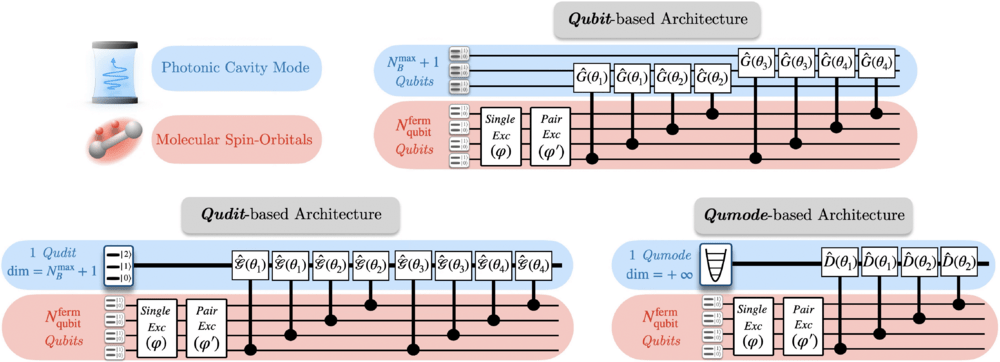
In the field of ab initio polaritonic chemistry, the use of quantum computers may offer, in the long term, a promising computational pathway for simulating and exploring novel cavity-induced light-matter phenomena. Addressing such problems on emerging platforms, however, already presents significant challenges that need to be considered for near-term applications. Within the framework of the variational quantum eigensolver (VQE), a key question concerns the development of quantum circuit Ansätze capable of encoding strongly correlated electron-photon states at a reasonable resource cost. Motivated by this question, in this work we develop different Ansatz strategies covering not only conventional qubit-based approaches but also higher-dimensional information units. Specifically, we introduce a set of circuits tailored to three different quantum computing architectures: (i) qubits, (ii) qudits, and (iii) hybrid qubit-qumode units of information. All circuits are designed to be both compact and physically motivated, with a central element being the development of spin-adapted electron-photon entangling fragment circuits tailored to the native capabilities of each platform. Integrating the different Ansätze within the state-averaged VQE, we numerically benchmark the three strategies on a cavity-embedded H2 molecule using state-vector simulations. Our results show that each proposed Ansatz achieves high accuracy in encoding the ground, first, and second polaritonic eigenstates of the system, even reproducing characteristic light-matter phenomena such as light-induced avoided crossings and conical intersections. This prospective work, beyond introducing multiple computational strategies adapted to different platforms, also highlights the potential of higher-dimensional quantum architectures to address hybrid fermion-boson systems.